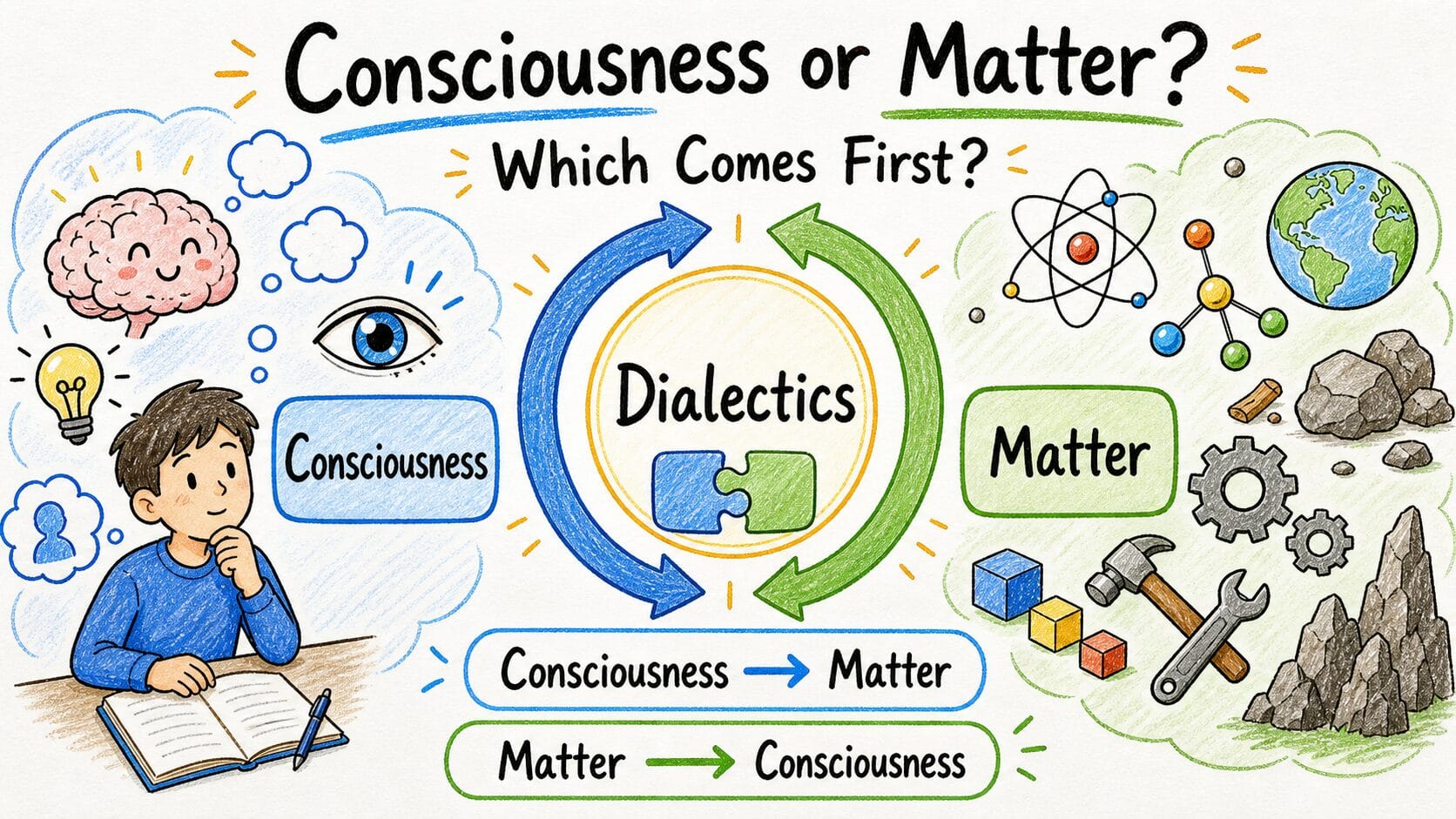
Consciousness First, or Matter First? — Rereading Miura Tsutomu’s What Kind of Science Is Dialectics? Through the Lens of a 2025 Universal Consciousness Hypothesis
Introduction — Why Place These Two Texts Side by Side?
In 1955, Miura Tsutomu published Benshōhō wa Dō Iu Kagaku ka (What Kind of Science Is Dialectics?) as part of Kodansha’s Million Books series (later reissued in 1968 through Kodansha’s Gendai Shinsho series). Reconceiving dialectics not as “philosophy” but as “science,” and illustrating its fundamental laws through a wealth of everyday examples, the book became a classic that has been read continuously for seventy years. Its central claim is unequivocal: matter is primary, and consciousness is merely a reflection of the material world.
In November 2025, Maria Strömme, a materials scientist at Uppsala University, published a paper in the peer-reviewed physics journal AIP Advances. Titled “Universal Consciousness as Foundational Field,” the paper flipped Miura’s claim precisely 180 degrees. Consciousness, Strömme argued, is the fundamental field of the universe, and matter, spacetime, and energy all emerge from it.
At first glance, these two texts appear to be in outright contradiction. One says “matter comes first”; the other says “consciousness comes first.” In the history of philosophy, this opposition has persisted for millennia — there is nothing new about it.
Yet when we place the two texts side by side and read them closely, something more than mere opposition emerges — a strange pattern of intersection. In this essay, I will first lay out the arguments of both, then analyze where they clash and where they cross, and finally — using the very method of dialectics that Miura himself taught, while drawing on the recent literature in relational ontology — attempt to aufheben (sublate) the two into a third perspective with the academic rigor it deserves.
- Part 1: What Did Miura Tsutomu Argue?
- Part 2: What Does Strömme’s Paper Argue?
- Part 3: Collision and Intersection
- Part 4: Aufhebung — Dialectics as the Laws of Motion of Internal Relations
- 4.1 Questioning the Question “Matter or Consciousness?”
- 4.2 The Primacy of Relations — Convergence in Contemporary Philosophy and Physics
- 4.3 Repositioning Dialectics — As the Laws of Motion of Internal Relations
- 4.4 Even “Relations” Are Not Substances — The Self-Application of Madhyamaka
- 4.5 The Causal Primacy of Material and Social Relations — Inheriting Miura’s Critical Edge
- 4.6 Anticipated 2,500 Years Ago — Dependent Origination and the Self-Application of Emptiness
- 4.7 Inheriting Miura’s Legacy
- Conclusion
Part 1: What Did Miura Tsutomu Argue?
Dialectics Is a “Science”
Miura’s starting point is a fundamental question about the status of dialectics: Is it “philosophy” or “science”? His answer is emphatic: the latter.
A note for English-speaking readers: Miura’s use of “science” here follows the broad Marxist–Engelsian sense of Wissenschaft — a systematic body of knowledge of general laws — rather than the narrower contemporary English sense of natural-experimental science. He treats dialectics as a Wissenschaft of the general laws of motion of nature, society, and thought. Reading “science” in the narrower contemporary sense would invite needless objection.
In the days before the individual sciences had matured, philosophy encompassed all of learning. But as physics, chemistry, and biology developed, the territories once claimed by philosophy were taken over by science, one after another. Dialectics is no exception. It must be treated as a Wissenschaft (a systematic knowledge of general laws) that elucidates the general laws of motion governing the world — this is Miura’s position.
The object dialectics addresses is the law of motion of the world itself. That water consists of hydrogen and oxygen; that light exhibits wave-particle duality — the individual sciences discover such facts one by one. Dialectics, building on those findings, elucidates the general laws that apply to the world as a whole.
The Three Fundamental Laws
Miura explains the three fundamental laws of dialectics with abundant concrete examples.
The First Law: The Interpenetration of Opposites. Everything in the world exists in relation to other things; no completely isolated entity is possible. Yet at the same time, each thing possesses a relative independence from others. “Connected and simultaneously not connected” — this seemingly contradictory expression is the starting point of dialectical relations. Miura illustrates this law through vivid examples: a policeman and a thief walking hand in hand, the meshing of gears.
The relationship between cause and effect is also reconceived dialectically. Metaphysics thinks in terms of a one-way arrow: cause → effect. But in dialectics, the effect becomes a cause in turn, and the child becomes a parent in turn — a cyclical, developmental relationship of mutual transition.
The Second Law: The Transformation of Quantity into Quality. When quantitative change exceeds a certain threshold (called the “measure” or “degree”), it converts into qualitative change. As the temperature of water rises and reaches 100°C, it undergoes a qualitative change from liquid to gas. A drug in small doses has no effect; in the right dose it heals; in excess it poisons; in greater excess it kills. Quantitative change is continuous, but qualitative change is discontinuous — a leap.
Moreover, qualitative change becomes the starting point for a new round of quantitative change. The chain quantity → quality → quantity → quality… constitutes the form of development.
The Third Law: The Negation of the Negation. The development of things follows not a simple linear progression but a spiral process: affirmation → negation → negation of the negation (a return to affirmation at a higher stage). A grain of seed is sown in the earth and sprouts (negation of the seed); the plant grows and bears new seeds (negation of the negation). The new seeds are “the same” as the original, yet what was one has become many. A return to the starting point — but one that contains development.
Materialism and Partisanship
An argument of Miura’s that must not be overlooked concerns the “partisanship” (Parteilichkeit) of learning.
Learning is neither neutral nor classless. The opposition between materialism and idealism is not merely a theoretical disagreement but reflects a difference in practical social standpoints. The ruling class tends toward idealism because it needs to justify its rule as eternal and natural, while the ruled class tends toward materialism because it faces material conditions head-on and seeks to transform them.
Miura further warns of the danger of beginning from a materialist position only to “fall” into idealism along the way. To be conscious of the partisanship in one’s learning and to constantly reflect on where one stands — this, Miura insists, is an indispensable condition for correct understanding.
“Doubling the World” and “Doubling the Self”
Miura develops an original analysis in epistemology as well. Through cognition, human beings “double” the world inside their heads — they create an image of the world separate from the actual world. Furthermore, humans can objectify themselves, gazing upon “another self” as if in a pair of facing mirrors. This capacity for “doubling the self” underpins all human cultural activity: language, art, and science.
What Miura emphasizes here is the direction of this doubling. The material world comes first, and human consciousness reflects and doubles it. Spirit does not produce the world; the world produces spirit. This is the core of materialism and the overarching premise that runs through all of Miura’s arguments.
Part 2: What Does Strömme’s Paper Argue?
The Three Principles — Consciousness Is the Foundation of the Universe
Maria Strömme’s paper takes as its starting point the “Three Principles (3Ps)” proposed by Sydney Banks:
- Mind: Universal creative intelligence. The source of all potential and the driving force of creation.
- Consciousness: The universal capacity for awareness. The substrate that enables all forms to be perceived and experienced.
- Thought: The creative mechanism that transforms the formless potential of Mind and Consciousness into individualized, structured realities.
These three principles are formless and eternal, existing before space, time, and matter. Consciousness does not arise from the brain; rather, the entire material world, including the brain, arises from the consciousness field — this is Strömme’s fundamental claim.
The Skeleton of the Mathematical Framework
Strömme formalizes this metaphysical claim in the mathematical language of quantum field theory.
Before the Big Bang, there exists an undifferentiated universal consciousness Ψ₀, with no time, no space, no matter. It is expressed as a superposition of all possible configurations of reality:
Ψ₀ = Σₖ(cₖΨₖ) — Eq. (1)
The “collapse” — the transition from the undifferentiated state to differentiated reality — is triggered by “universal thought” T̂:
T̂Ψ₀ = Ψₖ — Eq. (2)
Three pathways for this collapse are proposed.
First, symmetry breaking. The consciousness field follows a double-well potential V(Ψ) = λ(Ψ² − Ψ₀²)² and spontaneously breaks symmetry to differentiate — by analogy with the Higgs mechanism in particle physics.
Second, quantum fluctuations. Tiny perturbations Ψ → Ψ + δΨ accumulate and seed differentiation, much as quantum fluctuations during cosmic inflation seeded large-scale structure.
Third, self-reflection. Universal consciousness differentiates through the introspective act of observing itself, modeled via projection operators: Ψₖ = PₖΨ₀. A correspondence with Wheeler’s “participatory universe” is noted.
After the Big Bang, the differentiated consciousness field Ψ propagates through spacetime according to the d’Alembertian wave equation, and its localized excitations appear as individual consciousness — sentient beings:
T̂Ψₖ = Ψᵢ — Eq. (10)
Individual consciousness further shapes subjective experience through “personal thought” τ̂ᵢ:
τ̂ᵢΨᵢ = Ψ’ᵢ — Eq. (11)
Crucially, the separation of individuals is said to be an “illusion”; all consciousness remains connected to the universal field. Death is not annihilation but reintegration into the universal field.
Experimental Predictions
Strömme does not stop at pure speculation but offers several experimental predictions: correlations between random number generator (RNG) outputs and collective emotional events; brainwave synchronization patterns during meditation; and the existence of non-random structures in the cosmic microwave background (CMB). However, many of these predictions are methodologically contested, and rigorous experimental verification is still needed.
Part 3: Collision and Intersection
The Ontological Inversion — A Fundamental Clash
The opposition between the two could not be clearer.
Miura states: Matter is primary; consciousness is a reflection of the material world. Spirit does not produce matter; matter produces spirit. Dialectical laws are not concocted by the human mind; they inhere in the material world itself, and humans merely recognize them.
Strömme states: Consciousness is primary; matter is a differentiation of the consciousness field. Before the Big Bang, the consciousness field Ψ₀ existed, and matter, spacetime, and energy emerged from its collapse. The brain does not generate consciousness; a localized excitation of the consciousness field appears as the brain.
From Miura’s vantage point, Strömme’s paper is a modern incarnation of Hegel. Just as Hegel depicted the world as “the self-unfolding of the Absolute Spirit,” Strömme depicts the universe as “the self-differentiation of the universal consciousness field Ψ.” Miura criticized Hegelian dialectics as “standing on its head,” and the same criticism would be leveled at Strömme. Dressed up in the equations of quantum field theory, it is structurally idealism through and through — so the argument would go.
Yet Strömme’s side has a counter-argument. Physicalism has offered several responses to the “hard problem of consciousness” — why a collection of matter gives rise to subjective experience — including functionalism, higher-order representation theories, integrated information theory (IIT), and global workspace theory; but all remain contested, and none has decisively dissolved the hard problem. Placing consciousness at the foundation appears to bypass the problem — at the cost of generating new difficulties of its own: the combination problem (how individual consciousnesses differentiate and integrate from a universal one), the causal closure problem (how a non-physical consciousness field could act on physical processes), and the problem of connecting experience to physical law. Both the matter-foundation and consciousness-foundation positions face their own substantive puzzles, and which is preferable is not obvious — this is the candid state of contemporary philosophy of mind.
The Strange Sharing of Dialectical Structure
Despite the fundamental opposition, a striking structural similarity is discernible between the two. One caveat is in order before we proceed: Strömme’s paper is a speculative metaphysical model of a consciousness field, not an established physical theory. The “correspondence” set out below should therefore be read not as a verified isomorphism but as a structural analogy that admits of dialectical reading. With that qualification, Strömme — though she never uses the word “dialectics” — articulates a framework that exhibits intriguing structural parallels with the three laws of dialectics.
Interpenetration of opposites. In Strömme’s framework, universal consciousness and individual consciousness are opposed yet mutually interpenetrating. Individuals are differentiated as Ψₖ, yet they maintain entanglement with the underlying field Ψ. The relationship Miura described as “connected and simultaneously not connected” holds here as well.
Transformation of quantity into quality. The accumulation of quantum fluctuations δΨ in the consciousness field triggers symmetry breaking — a qualitative transformation. The structure whereby continuous quantitative change converts into discontinuous qualitative change (the Big Bang as a “leap”) follows exactly the same logic Miura explained using the example of water boiling.
Negation of the negation. Undifferentiated unity (Ψ₀) → differentiation and individuation (Ψₖ, Ψᵢ) → reintegration into the universal field through death. It seems to return to the same starting point, yet it stands at a higher stage, enriched by experience and differentiation. The spiral structure Miura illustrated with the grain of seed is reproduced on a cosmic scale.
In other words, dialectics starting from matter and cosmology starting from consciousness appear to share a structure that admits of being read as the same form of laws of motion. Is this coincidence — or is something at work that crosses the difference of starting points?
“Doubling the World” and “Self-Reflection” — A Mirror Correspondence
One of the most original concepts in Miura’s epistemology is “doubling the world” and “doubling the self.” Through consciousness, human beings replicate the world inside their heads and can further objectify themselves to gaze upon themselves.
Strömme’s “differentiation through self-reflection” (Ψₖ = PₖΨ₀) is strikingly similar in structure. The claim that differentiation arises from the act of universal consciousness observing itself is a mirror inversion of Miura’s “doubling of the self.” In Miura, a material being doubles consciousness; in Strömme, consciousness reflects itself and generates matter.
The two are diametrically opposed in direction, yet they agree on one point: a recursive structure of self-objectification lies at the root of both creation and cognition. This is noteworthy.
Turning Miura’s Weapon Upon Himself
Miura demanded of his readers that they become conscious of the “partisanship” in their learning — that constantly reflecting on where one stands is an indispensable condition for correct understanding.
Let us turn that weapon upon Miura himself.
From his materialist dialectical standpoint, Miura linked idealism with the self-justification of the ruling class. But this analysis is itself bound by a particular historical context — Cold War Japan, an era when Marxism held intellectual authority. To claim that any position regarding consciousness as fundamental is ipso facto a ruling-class position is surely an oversimplification.
The Advaita Vedānta and Buddhist śūnyatā that Strömme’s paper references developed among Indian ascetics and cannot easily be associated with ruling-class self-justification. Indeed, these traditions, which teach the illusory nature of the phenomenal world, have the power to relativize existing structures of power.
Furthermore, if we follow the logic of the “negation of the negation” — the third law Miura himself expounded — then materialism, too, must pass through negation to develop into a higher stage. To cling to materialism while remaining unable to adequately address the problem of consciousness is to obstruct the very development of dialectics.
Miura said that dialectics is not a completed system but “something that must be developed through ceaseless confrontation with reality.” If we take those words seriously, then fleeing from the confrontation with the “reality” of the hard problem of consciousness cannot be permitted.
The Limits of Strömme — What the Absence of Dialectics Produces
On the other hand, Strömme’s paper has serious limitations of its own.
The most fundamental problem is that it does not explain why the collapse occurs. Why did the perfectly undifferentiated consciousness field Ψ₀ need to differentiate in the first place? Strömme states that “universal thought T̂ initiates the collapse,” but as to why T̂ acts, she offers only the tautological explanation of “the creative force of Mind.”
How might one tentatively reconstruct this question from a Miura–Marxist dialectical perspective? In dialectics, the driving force of motion is located not in an external force but in contradiction internal to the framework. The moment Strömme defines Ψ₀ as “the superposition of all possible differentiated states,” it already contains both “undifferentiated unity” and “potentiality toward differentiation” — and these two can be read as intrinsically in tension, the potentiality generating a strain toward actualization. So reread, the driver of collapse would not be a “creative force of Mind” summoned from outside but a structural tension built into the definition of Ψ₀ itself. This is more internally consistent than invoking Mind, but it remains one interpretation, not a proof. Since Strömme does not herself write in dialectical idiom, the present rereading is offered as a constructive alternative rather than as a critique.
Moreover, Strömme’s framework almost entirely lacks a social and historical dimension. The social contradictions that Miura persistently pursued — the “interpenetration between human beings” through labor, exchange, exploitation, and class struggle — find no place whatsoever in Strömme’s universal consciousness field. Individual consciousnesses Ψᵢ are treated as equal excitations of the universal field Ψ, but in actual society consciousness is never equally distributed. Access to education, information, and power is uneven, and the material conditions that produce that unevenness are precisely what Miura called the “base.”
Even if placing consciousness at the foundation resolves the “hard problem,” if the price is the loss of the capacity to analyze social contradictions, then it is a different kind of “fall.”
Part 4: Aufhebung — Dialectics as the Laws of Motion of Internal Relations
4.1 Questioning the Question “Matter or Consciousness?”
What the foregoing analysis suggests is that materialist dialectics and Strömme’s consciousness-field hypothesis, while ontologically diametrically opposed, appear — if we accept the analogical reading offered in the previous part — to share a structure that admits of being read as the same form of laws of motion.
The interpenetration of opposites, the transformation of quantity into quality, the negation of the negation — these laws can be read as appearing in the same form whether the starting point is “matter” or “consciousness.” Like left and right hands, they look as if they stand in a mirror relation while sharing the same skeletal structure — a heuristic image, not a proven identity.
This reading suggests a possibility: the laws of dialectical motion are a more fundamental structure that precedes both matter and consciousness.
Miura located the laws of dialectics as “laws inherent in the material world.” Strömme (without using the word dialectics) described isomorphic laws as “inherent in the consciousness field.” But if a structure common to both exists, that structure may belong to a third level irreducible to either matter or consciousness.
4.2 The Primacy of Relations — Convergence in Contemporary Philosophy and Physics
The position I wish to propose — that “relations” are fundamental — is not an isolated speculation. It is the conclusion forced upon us by the convergence of multiple independent intellectual currents that have developed since the latter half of the twentieth century. Let me briefly survey this convergence.
(1) The “philosophy of internal relations” in Marx scholarship — Bertell Ollman. The political theorist Bertell Ollman identified the logical foundation of Marx’s dialectic as the “philosophy of internal relations”: the position that the identity of a term is not constituted independently of its relations but precisely by those relations. Worker and capitalist, commodity and money — these cannot be understood in isolation from their mutual relations. This reading is in fact internally present in Miura’s own concrete analyses, to a degree that does not entirely sit comfortably with his surface materialist declarations.
(2) The state-of-the-art in dialectical theory — Thomas Bidell, “Internal Relations as the Basis of Dialectics” (2024). In Chapter 11 of The Routledge International Handbook of Dialectical Thinking (2024), Bidell argues that the heart of Hegelian dialectics is the philosophy of internal relations. He characterizes internal relations through three constitutive components: (i) the inter-participation of parts, (ii) the self-movement of parts and wholes, and (iii) the aufheben through which the self-movement of inter-participating parts produces contradictions resolved by destruction, preservation, and reorganization into new wholes. The framework Bidell develops independently confirms the present essay’s central claim from within current dialectical scholarship.
(3) Karen Barad’s agential realism. Drawing on the philosophy of quantum mechanics, Barad argues that “relations do not follow relata, but the other way around.” Her concept of intra-action stands in sharp contrast to “inter-action,” which presupposes pre-existing independent terms. In Barad’s ontology, terms themselves emerge within intra-action; “there are no independent relata, only relata-within-relations.”
(4) Ontic Structural Realism (OSR). Represented by James Ladyman and Don Ross among others, contemporary philosophy of science increasingly locates the persistent core of scientific theories in “structures” (i.e., patterns of relations) rather than in “the nature of things.” Radical OSR pushes this further, arguing that networks of relations without relata are ontologically basic.
(5) Carlo Rovelli’s Relational Quantum Mechanics (RQM). “The value of any physical quantity is meaningful only in relation to another system”; “the physical content of the theory is not about objects in themselves but about the relations between them.” These are RQM’s central tenets. Quantum non-separability in entanglement demonstrates the ontological primacy of relations irreducible to their relata.
(6) Madhyamaka philosophy and process philosophy. Nāgārjuna’s teaching of dependent origination and emptiness, and Whitehead’s process philosophy, have for two millennia or more developed worldviews that do not rely on self-subsistent substances.
These six currents differ in motivation, tradition, and vocabulary, and their scopes and presuppositions are not identical. To be properly cautious, the standing of each should be acknowledged: Rovelli’s RQM is one among several interpretations of quantum mechanics — a minority position alongside the many-worlds and Copenhagen interpretations; Radical OSR remains contested within structural realism, criticized for its handling of Bradley’s regress and the coherence of relations without relata; Barad’s intra-action is widely received in gender studies and STS but is not mainstream within analytic philosophy; the analogy between Madhyamaka and contemporary physics is suggestive but has a history of being over-stretched; and Bidell’s chapter, though a recent contribution to dialectical theory, is itself a proposal rather than established orthodoxy.
It would therefore be inaccurate to claim that these currents endorse a single shared position called “the primacy of relations.” What is nonetheless noteworthy is that, having developed independently of one another, they all gesture toward taking relations as primary over their terms. The position is not the sole mainstream of contemporary philosophy and physics, nor do all these currents support precisely the same proposition; but it stands at the intersection of several non-negligible currents and is, on that basis, a carefully defensible (rather than a triumphant) position — and that is how the present essay positions it.
4.3 Repositioning Dialectics — As the Laws of Motion of Internal Relations
In light of this convergence, dialectics can be repositioned as follows.
Dialectics is neither “the laws of motion of matter” nor “the laws of motion of consciousness” but the laws of motion of internal relations. The qualifier “internal” is important.
The word “relation” carries at least the following distinct senses: (a) internal relations (Hegel, Ollman, Bidell, Barad) — the identity of a term is constituted by its relations; (b) external relations (Russell, Hume) — terms exist independently and relations are added externally; (c) physical interactions (Rovelli); (d) intra-actions (Barad); (e) social relations (Marx); (f) intentional relations (phenomenology). Conflating these would let the “matter or consciousness?” question reenter through the back door.
Dialectics tracks (a), internal relations: opposed terms do not happen, accidentally, to enter relation upon their independent foundations; rather, the terms themselves are mutually constituted within the relation. Miura’s discussions of “worker and capitalist,” “self and other,” “right and duty” are all instances of internal relations.
Within this restriction, the three laws can be reformulated more precisely:
Reformulated First Law (Interpenetration of Opposites): Terms do not pre-exist their external connection; they are mutually determined within an internal relation. Opposition is not imposed from outside the relation but is intrinsic to it.
Reformulated Second Law (Transformation of Quantity into Quality): Here arises the harder question — what is the “quantity” of a relation? Rather than a mere increase in number, “quantity” should be understood as continuous variation in relational-structural parameters: density, configuration, depth of mediation, coupling strength, topological features. When these parameters cross critical thresholds, the form (type, topology) of the relation itself undergoes discontinuous transformation. What changes when a discussion circle moves from intimate small-group dynamics to mass-meeting structure is the complexity of the relational structure; what changes when water boils is the qualitative pattern of inter-molecular relations.
Reformulated Third Law (Negation of the Negation): A given relational form, by harboring contradictions internally, negates itself; in doing so it preserves elements of the older form (the dual sense of aufheben) while developing spirally into a higher-order relational form. This corresponds precisely to Bidell’s formulation of “self-movement, contradiction, and aufheben.”
So reformulated, the opposition between Miura and Strömme is aufheben: material relations (Miura) and conscious relations (Strömme) are different manifestations resting on the common ground of internal relations.
4.4 Even “Relations” Are Not Substances — The Self-Application of Madhyamaka
We must now confront a serious philosophical difficulty head-on: does the assertion “relations are fundamental” not itself substantialize relations as a third entity?
This problem corresponds to the classical regress F. H. Bradley diagnosed: if “relation R holds between terms a and b,” then between R and a there must be a further relation R’, and between R’ and a a yet further R’‘, ad infinitum. To assert “only relations exist” leaves us asking: relations of what? Is a relation without relata not a contradiction in terms?
The most refined response to this difficulty is the two-truths (saṃvṛti / paramārtha) structure of Nāgārjuna’s Madhyamaka.
At the level of conventional truth (saṃvṛti-satya), relations function between terms; cause and effect are linked; social relations bind worker and capitalist. Miura’s dialectical descriptions are wholly valid at this level.
At the level of ultimate truth (paramārtha-satya), however, relations themselves lack self-existing nature (svabhāva) — that is, they are empty (śūnya). To posit relations as a new substance that replaces matter or consciousness would be to repeat the very substantialism Nāgārjuna exhaustively dismantled in the Mūlamadhyamakakārikā: “Neither from itself, nor from another, nor from both, nor without a cause, does anything whatever, anywhere, arise” (Chapter 1).
What is critical here is Nāgārjuna’s strict warning against substantializing “emptiness” itself (śūnyatā-śūnyatā, “the emptiness of emptiness”). The “web of relations” is no exception. To reify it as “a dynamic structure that enables all phenomena to come into being” would push us right back to Nāgārjuna. If we follow Madhyamaka through to the end, nothing can be positively asserted at the ultimate level. The most one can coherently say at the conventional, analytic level is this: what we track, as a method of analysis, is not isolated terms but relations. The web of relations is not posited as something that exists; rather, as an analytic stance we trace relations rather than self-subsisting things.
This self-application has an important consequence. The “primacy of relations” should be read not as a final ontological answer but as a methodological orientation:
Dialectics is the method of analysis that tracks objects not as isolated self-subsisting terms but as the movement of internal relations. When this method is applied, even “relation” is not the final substance but is itself an object subject to de-substantialization.
This is consistent with Miura’s own characterization of dialectics as both “worldview and method.” Miura insisted that dialectics is not a closed dogma but “something that must be developed through ceaseless confrontation with reality.” To substantialize “relation” would be to fall into the very dogmatism Miura warned against.
The Bradley regress arises only when relations are reified. If, in Madhyamaka fashion, relations themselves are de-substantialized, the infinite regress dissolves, since each step in the regress would require a substantialized relation that this view denies.
4.5 The Causal Primacy of Material and Social Relations — Inheriting Miura’s Critical Edge
A bare assertion of “the primacy of relations” risks losing the critical edge of Miura’s dialectics. The very limitation we found in Strömme — the loss of capacity to analyze social contradictions — would also threaten an unrestricted “relations in general” thesis. If all relations are treated as equivalent, we cannot explain why warming becomes climate disaster, or why wage cuts prepare revolution.
In response, this essay proposes the following hierarchical position. It is not put forward as a dogmatic principle but as a working hypothesis for the analysis of actual phenomena:
Within the ontological framework of “the primacy of relations,” in many observable cases, materially and socially mediated relations tend to enjoy causal primacy over purely ideational relations.
The conditions, reactions, and limits of this proposition should be made explicit:
(a) Conditions of holding: Ideational relations (theories, ideologies, art) depend on the material substrate of the subjects who carry them (brain, body) and on the social conditions that transmit and circulate them (education, media, economic surplus, institutions). Changes in material/social relations therefore impose strong constraints on ideational relations — abstract thought becomes difficult under starvation; poverty constrains educational opportunity; censorship blocks the propagation of ideas. These are empirically observable tendencies.
(b) Existence of reaction: Ideational relations are not, however, passively determined; they react back upon material/social relations. As Marx himself wrote, “theory becomes a material force when it grips the masses.” Revolutionary ideas transform material conditions; scientific discoveries change technology and modes of production. The two domains interpenetrate. The “primacy” here is not absolute domination but a statistical, tendential asymmetry.
(c) Limits: Where mathematical or logical relations, or self-reflective levels of cognition, are concerned, the claim of material primacy weakens. “2+2=4” does not depend on economic structure. At the level of individual subjective choice or contingent events, material conditions impose probabilistic constraints rather than determinations.
The relational materialism advanced here, then, is not a return to the older mechanical base-determinism but a position that recognizes asymmetry within interpenetration. It is not advanced as a strong metaphysical claim but defended as a working hypothesis for social analysis, to be revised if disconfirmed.
This is territory already opened up by Roy Bhaskar’s critical realism and recent work by Andrew Brown and others. Marx’s famous proposition — “It is not the consciousness of men that determines their being, but, on the contrary, their social being that determines their consciousness” — is recast in the relational-materialist register as: ideational relations are tendentially generated and constrained by social and material relations, while remaining capable of reacting back upon them.
Under this hierarchical stance, Strömme’s universal-consciousness-field hypothesis can carry some significance as inquiry at the level of ideational relations, but the claim that it stands self-sufficient, severed from material and social relations, is rejected. A response to the hard problem of consciousness must not be paid for by abandoning the analysis of social contradiction. This is the critical posture to be inherited from Miura.
4.6 Anticipated 2,500 Years Ago — Dependent Origination and the Self-Application of Emptiness
Broadening our view, the conclusions of this essay — the primacy of relations, the restriction to internal relations, the de-substantialization of relations themselves, and the hypothesis-grade preservation of a tendential causal asymmetry favoring material and social mediation — resonate deeply, at the conventional/analytic level, with the teachings of dependent origination (pratītyasamutpāda) the Buddha expounded 2,500 years ago, and with the Madhyamaka systematized by Nāgārjuna.
Dependent origination holds that all things arise through causes (hetu, direct causes) and conditions (pratyaya, indirect conditions), and that nothing exists independently and self-sufficiently. “When this exists, that comes to be. With the arising of this, that arises. When this does not exist, that does not come to be. With the cessation of this, that ceases” (Saṃyutta Nikāya). Existence is not substance but relation; it is process.
In the Mūlamadhyamakakārikā, Nāgārjuna pushes this logic to its limit, dismantling any substantialist account of arising, motion, time, self, and causality through the four-cornered negation (catuṣkoṭi). It is common to gloss “emptiness” (śūnyatā) as “the absence of svabhāva understood within a dynamic relational structure”; but as established in §4.4, that kind of gloss already risks the very substantialization Madhyamaka resists. Critically, Nāgārjuna does not permit even emptiness to be reified: emptiness itself is empty (śūnyatā-śūnyatā). This is precisely the self-application structure invoked above.
This teaching of dependent origination resonates with all three positions examined in this essay, yet is reducible to none of them.
Miura’s dialectics holds: “Opposites mutually presuppose and interpenetrate each other. No isolated substance exists.” This overlaps with the “mutual dependence” of dependent origination. The logic of mediation Miura illustrated in the gear-meshing diagram — “A is linked to C through B” — is the very structure of pratyaya (conditions).
Strömme’s consciousness-field hypothesis holds: “The separation of individuals is an illusion; everything exists as relations within the universal field.” This resonates with śūnyatā derived from dependent origination. Strömme herself references Buddhist emptiness; yet by re-reading it as “universal consciousness as a new substance,” she retreats from Nāgārjuna’s thoroughgoing self-application.
Confronted with binary metaphysical questions — “Is the world eternal or non-eternal?” “Is the self identical with the body or different from it?” — the Buddha adopted the stance of avyākata, the unanswered. This is not indifference or agnosticism but an active refusal: the very framing of the question is mistaken.
“Does matter come first, or consciousness?” is, from the standpoint of dependent origination, just such a mistaken binary. Matter and consciousness arise in mutual dependence; the question of which comes “first” reifies one term of a relation. Miura reified matter; Strömme reified consciousness. Dependent origination and emptiness reject both.
The position presented here as “the laws of motion of internal relations” can be said, at the conventional/analytic level, to resonate with — and offer one possible modern re-reading of — a line of thought Buddhist philosophy has refined over a long history. Asserting full identity between the two would require ignoring genuine differences in conceptual framework and the well-known history of overstretched analogies between Madhyamaka and modern physics.
4.7 Inheriting Miura’s Legacy
The position developed in Part 4 has the following layered structure:
- Methodological level: Dialectics is the method of analysis that tracks objects as the movement of internal relations rather than as isolated self-subsisting terms.
- Cross-domain level: This method applies across material, conscious, and social domains, each of which exhibits its own characteristic laws of motion.
- Ontological level (qualified): The shared form of these laws (interpenetration, quantity-quality, negation-of-negation) reflects the primacy of internal relations — terms do not precede relations but are constituted within them.
- Self-application level: Even “internal relations” are not self-subsisting substances (dependent origination, emptiness). This avoids Bradley’s regress not by infinite tolerance of regress but by the Madhyamaka two-truths structure.
- Critically inherited materialism: Among relations cross-domain-wise, materially and socially mediated relations exhibit, in many observable cases, a tendential causal primacy over purely ideational ones — offered as a working hypothesis with explicit conditions, reactions, and limits. Through this tendential and hypothesis-grade hierarchy, Miura’s critical edge is preserved.
This position does not negate Miura’s legacy; it inherits its best parts.
What Miura devoted his life to pursuing was the apprehension of the world not as fixed but in motion, change, and development — grasping “things” not as fixed substances but dynamically, within “relations.” That is the quintessence of dialectics.
Miura held materialism to be the indispensable foundation of dialectics. In his time, this was a justified judgment. Yet as Miura himself stated, dialectics is “something that must be developed through ceaseless confrontation with reality.” The advance of quantum mechanics, the discovery of the hard problem of consciousness, the appearance of consciousness-field hypotheses like Strömme’s, and the systematic articulation of relational ontology by Bertell Ollman, Karen Barad, Carlo Rovelli, Thomas Bidell, and others — through confrontation with these “realities,” dialectics itself can pass through the negation of the negation and develop into a higher stage.
To move beyond the binary of “matter first or consciousness first” and to stand at the point where “internal relations are the basis of dialectics” — without substantializing those relations and while preserving the causal primacy of material and social relations — is nothing other than the consequence of applying Miura’s own method of dialectics (“not either/or but both/and”) to Miura’s own question.
Conclusion
Reading Miura Tsutomu from 1955 and Strömme from 2025 side by side was a curious experience. Two texts separated by seventy years illuminated each other’s limitations and possibilities like a pair of facing mirrors.
Miura’s richness of concrete examples and his demand for consciousness of partisanship still offer much to learn from. But a materialist dialectics without the reach to address the hard problem of consciousness faces limits in its persuasiveness in the intellectual landscape of the twenty-first century.
Strömme is provocative in her bold hypothesis and mathematical formulation, but owing to the absence of dialectical thinking, she fails to fully capture the laws of motion within her own framework and leaves social contradictions unaddressed.
The third position that sublates the two — dialectics as the laws of motion of internal relations — is located at a point already indicated by the convergent currents of Bertell Ollman, Karen Barad, Thomas Bidell, Carlo Rovelli, ontic structural realism, and Madhyamaka philosophy. This essay has presented the position not as bare “relationism” but as a relational materialism characterized by three requirements: (i) restriction to internal relations, (ii) Madhyamaka-style self-application that prevents the substantialization of relations themselves, and (iii) preservation of a tendential, working-hypothesis-grade causal asymmetry that gives weight to material and social mediation.
This position is not finished. How to measure the “quantity” of a relation; how to draw the boundary between internal and external relations; how to refine the hierarchy among relations — many tasks remain. But it offers, at the very least, a starting point for re-examining the very framing of the question “matter first or consciousness first?” — a question that has persisted for two millennia.
As Miura emphasized repeatedly, the essence of learning dialectics lies not in resting content with ready-made answers but in facing the contradictions of reality head-on and continuing to think for oneself. If this essay serves as a modest aid to that end, so much the better.
References
Primary works – Miura, Tsutomu. Benshōhō wa Dō Iu Kagaku ka (What Kind of Science Is Dialectics?). Kodansha Million Books, 1955 (reissued: Kodansha Gendai Shinsho, 1968). – Strömme, M. “Universal consciousness as foundational field: A theoretical bridge between quantum physics and non-dual philosophy.” AIP Advances 15, 115319 (2025). DOI: 10.1063/5.0290984
Internal relations and dialectics – Ollman, B. Alienation: Marx’s Conception of Man in Capitalist Society. Cambridge University Press, 1976. – Ollman, B. Dance of the Dialectic: Steps in Marx’s Method. University of Illinois Press, 2003. – Ollman, B. “Marxism and the philosophy of internal relations; or, How to replace the mysterious ‘paradox’ with ‘contradictions’ that can be studied and resolved.” Capital & Class 39(1), 7–23 (2015). – Bidell, T. “Internal Relations as the Basis of Dialectics.” In Shannon, N., Mascolo, M. F., & Belolutskaya, A. (eds.), The Routledge International Handbook of Dialectical Thinking, Routledge, 2024, pp. 105–126.
Relational ontology and quantum mechanics – Bohm, D. Wholeness and the Implicate Order. Routledge, 1980. – Rovelli, C. “Relational Quantum Mechanics.” International Journal of Theoretical Physics 35, 1637–1678 (1996). arXiv:quant-ph/9609002. – Barad, K. Meeting the Universe Halfway: Quantum Physics and the Entanglement of Matter and Meaning. Duke University Press, 2007. – Ladyman, J. & Ross, D. Every Thing Must Go: Metaphysics Naturalized. Oxford University Press, 2007.
Philosophy of mind and consciousness – Schrödinger, E. What is Life? Cambridge University Press, 1944. – Chalmers, D. “Facing Up to the Problem of Consciousness.” Journal of Consciousness Studies 2(3), 200–219 (1995).
Buddhist philosophy: dependent origination and emptiness – Nāgārjuna. Mūlamadhyamakakārikā (Fundamental Verses on the Middle Way). c. 2nd century CE. – Saṃyutta Nikāya 12:1, Nidāna Saṃyutta (Dependent Origination). – Garfield, J. L. The Fundamental Wisdom of the Middle Way: Nāgārjuna’s Mūlamadhyamakakārikā. Oxford University Press, 1995.
Critical realism and relational materialism – Bhaskar, R. Dialectic: The Pulse of Freedom. Verso, 1993. – Brown, A. “From Critical Realism to Materialist Dialectics.” Journal of Critical Realism (2007).
Background metaphysics – Bradley, F. H. Appearance and Reality. Swan Sonnenschein, 1893. (On the regress of relations.)


コメント